The 1976 Seoul UFO Incident: A Balloon Hypothesis, Checked Against the Weather Data
Introduction
On the evening of October 14, 1976, an unidentified group of lights appeared over Seoul, and anti-aircraft units fired on it three times. Falling shell fragments killed one civilian and injured 31 others. Newspapers at the time reported that a Northwest Airlines Boeing 707 cargo flight, flight 902, had strayed into a no-fly zone and been fired on by mistake — and given the political climate of the period, this was effectively the government's official position.
That explanation conflicts with witness[1][2] testimony on two points. First, the count: multiple witnesses described seeing several objects, and one counted twelve. A single aircraft cannot appear as twelve. Second, the flight path: flight 902 took off from Gimpo Airport's runway 32, crossed south of the Han River, and exited to the east. All the witnesses, by contrast, were north of the Han River, and one reported the object passing directly over Gyeongbokgung Palace — more than 5 km (3 miles) north of the river.
The testimony comes from witnesses who appeared in episode 1238 #of SBS's Unanswered Questions. A fourth witness was excluded from the analysis, as his recollection appeared too uncertain. ↩︎
A note on sourcing: several of the witness accounts referenced below come from a episode #1238 (2020) of the SBS program Unanswered Questions(그것이 알고싶다). It's a long-running Korean investigative documentary series — part cold-case journalism, part mystery/conspiracy programming — that has covered this incident and interviewed surviving witnesses. It is a domestic Korean broadcast program. As of 2026, the show is available on Netflix, but episode #1238 must be watched on SBS's official website. ↩︎
Online discussion of the case tends toward two other explanations: an extraterrestrial craft, or a downed craft whose wreckage the government concealed. Neither has any wreckage, photograph, or surviving radar record behind it, so neither can be checked.
This post argues for a third explanation: a string of twelve balloons at high altitude, still catching sunlight after ground-level sunset. Unlike the other explanations, this one can be checked — against the witness testimony and against actual meteorological data recorded that evening.
Body
Timeline of the evening
| Time (KST) | Event |
|---|---|
| 17:30 | First round of fire (still daylight) |
| 17:57 | Sunset |
| After 18:00 | Fighter jets scrambled |
| 18:12 ~ 18:14 | Second round of fire (lasted ~2 minutes) |
| 18:38 | Third round of fire |
Three rounds were fired, not two. This matters later.
1. The guns couldn't have reached it
The most commonly repeated mystery about this incident is why, after all that firing, nothing was ever brought down.
The guns used were 20mm anti-aircraft cannons — capable of thousands of rounds per minute, but with a maximum vertical reach of only 4–5 km (2.5-3 miles), and an effective range closer to 1.5 km (1 mile). Firing faster doesn't change how high a shell can go; it only changes how many shells go up in a given time.
If the object was above 5 km (3 miles), nothing should have come down. No wreckage should exist. The shells simply never got there.
2. Witness ① — saw the lights and the tracer fire together
The first witness was partway up Geumhwasan Mountain, a small mountain in western Seoul, and happened to be an amateur stargazer. His account:
- Twelve objects
- Evenly spaced
- Moving from the western sky toward Gyeongbokgung Palace
- Anti-aircraft tracer fire visible at the same time
Even as someone used to identifying stars, this witness didn't immediately recognize the lights as anything other than stars — meaning their apparent size was small enough to be indistinguishable from starlight.
The fourth point matters most. The second round of fire lasted from 18:12 to 18:14 — two minutes, not an instant. If the witness saw the lights and the tracers in the same view, the objects were still lit at that time. And how high the Earth's shadow had climbed by that moment can be calculated.
Earth's shadow, seen edge-on
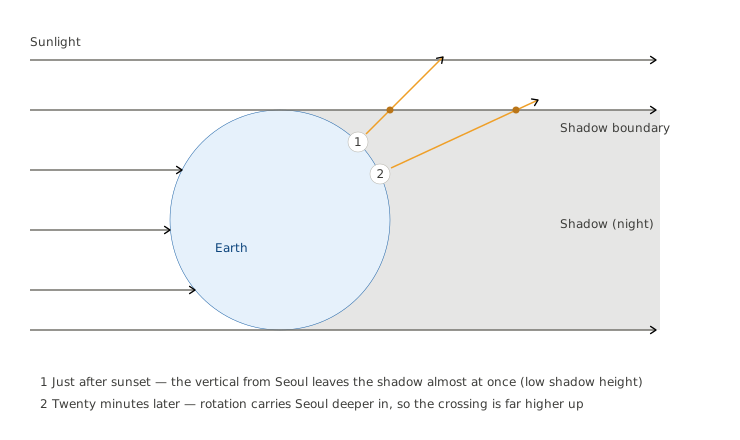
Sunlight arrives from the left in parallel rays; Earth blocks it, casting a shadow to the right. What matters here is the vertical line straight up from Seoul (in orange). Where that line crosses the shadow boundary marks the height below which it's dark and above which sunlight still reaches.
As Earth rotates and Seoul moves from position 1 to position 2, that vertical line goes deeper into the shadow, and the crossing point rises. This is why darkness climbs after sunset instead of arriving everywhere at once — the ground goes dark first, and higher altitudes stay lit longer. It's the same reason a mountain peak stays bright after the valley below it has gone dark, or why a high contrail glows pink well after ground-level sunset.
Shadow height over Seoul that evening
| Time | Height below which it was dark |
|---|---|
| 18:00 | 0.4 km (1,300 feet) |
| 18:05 | 2.5 km (8,200 feet) |
| 18:10 | 6.5 km (21,300 feet) |
| 18:12 | 8.6 km (28,200 feet) |
| 18:15 | 12.4 km (40,700 feet) |
| 18:20 | 20.2 km (66,300 feet) |
At 18:12, when the second round of fire began, the shadow had already climbed to 8.6 km. If the object was still lit at that moment, it was above that height — roughly the cruising altitude of a passenger jet, or higher.
3. Witness ③ — direction and manner of disappearance
The third witness was in Pirun-dong, west of Gyeongbokgung. He described the object appearing over the palace, moving toward Daehangno, and gradually fading while seeming to shrink in number as it receded.
On a map, Pirun-dong, Gyeongbokgung, and Daehangno line up almost exactly east–west — bearing 77° to the palace, 82° to Daehangno from the witness's position. This witness was looking almost directly along the object's path as it moved away, putting the direction of travel at roughly bearing 80° (east, slightly north).
The detail about the count shrinking carries information too. A self-luminous object receding would simply dim as a whole, not lose members one at a time. Losing members one at a time points to a different mechanism — and as the diagram shows, Earth's shadow rises first from the east. An eastbound line of objects would have its easternmost members enter the shadow and go dark first, one after another.
This is the same effect behind modern reports of Starlink satellite trains — a line of lights, moving together, going dark one end at a time. The cause is the same: entering Earth's shadow. The object was most likely not self-luminous but reflecting sunlight.
4. What the wind was actually doing that night
Everything so far rests on testimony and calculation. There's also a direct measurement to check it against.
Osan Air Base ran daily weather-balloon soundings, and the record for the evening of October 14, 1976 survives in the U.S. NOAA's archive. That night's balloon reached 32.5 km (20 miles) — well above the altitude range in question, and about two and a half hours after the incident.
The direction the wind was carrying objects, by altitude:
| Altitude | Direction objects would drift |
|---|---|
| 1.5 km (4,900 feet) | South (bearing 180°) |
| 3 km (9,800 feet) | South (bearing 165°) |
| 5.7 km (18,700 feet) | Southeast (bearing 130°) |
| 8 km (26,200 feet) | Southeast (bearing 120°) |
| 9.3 km (30,500 feet) | Nearly due east (bearing 85°) |
| 12 km (39,400 feet) | Nearly due east (bearing 80°) |
| 15 km (49,200 feet) | Nearly due east (bearing 80°) |
| 18.5 km (60,700 feet) | Nearly due east (bearing 80°) |
The wind shifts sharply between 8 and 9 km (26,000-30,500 feet). Below that, it blows south; above it, east.
Witnesses reported eastward motion. If the object had been at a low altitude — 2 to 5 km (6,500 to 16,500 feet ) — that night's wind would have carried it south, not east. Eastward motion places it above roughly 9 km (30,000 feet).
The floor derived from sunlight timing (8.6 km ; 28,200 feet) and the floor derived from measured wind (9 km ; 30,000 feet) come from two completely independent methods and land on nearly the same number. The direction matches too — the bearing of ~80° computed from witness geometry matches the measured wind direction at 9–19 km (30,000–62,000 feet) almost exactly.
5. Witness ② — the formation was spread across the sky
The second witness was at the main gate of the Blue House (the presidential residence), looking toward Bugaksan, the mountain just north of it.
At roughly the same moment during the second round of fire, witness ① (on Geumhwasan Mountain) was looking west, witness ② (at the Blue House) was looking north, and witness ③ (in Pirun-dong) was looking east. All three were within 3 km (1.8 miles) of each other, yet each pointed in a different direction. A single tight cluster couldn't produce that. It's more consistent with twelve objects spread widely across the sky, with each witness seeing a different member of the group.
6. The military was tracking it by radar
The first round of fire, at 17:30, came while the sun's elevation was still +4.4° — full daylight. No witness reported seeing anything at that time. The third round, at 18:38, came after Earth's shadow had risen past 60 km (200,000 feet), meaning the objects had long since gone dark. Again, no witness saw anything. Both rounds were fired at a target invisible to the naked eye.
Contemporary news reports mention something showing up on radar. That suggests the military's detection was never visual — it was tracking the object(s) by radar the whole time, which explains why it responded before any witness could see anything and kept firing after the lights had gone out.
This also says something about the object itself. To register on radar, something has to reflect radio waves; a thin plastic balloon envelope alone reflects weakly. It's plausible that a metal reflector or instrument package was attached.
7. A note on the "came from the south, vanished to the northwest" account
Separately from the three broadcast witnesses, a story of unknown origin has long circulated in Korea describing the object approaching from the south and disappearing to the northwest — seemingly the opposite of the eastward motion established above. Checking the wind data at every altitude from ground level to 32 km (105,000 feet), there is no layer with a wind component that would carry an object northwest.
The discrepancy resolves if the vantage point is different. All three named witnesses were in northwestern Seoul, at or near the formation's ground track. Someone watching from southeast of the city would see something else entirely.
From roughly 30 km (18.6 miles) southeast of the formation, an object over downtown Seoul would appear high in the northwest sky. As the eastern members went dark first and the remaining light retreated westward, its bearing from that vantage point would shift from about 315° to 292°, and its elevation would drop from roughly 28° to 10° — a bright object high in the northwest, sinking and fading toward the northwest. Conversely, while the formation was still approaching from the west, the same observer would first see it in the northwest, with its bearing swinging back toward north as it arrived — which could easily be described as "coming down from the south."
It's plausible that this is the same event described from a different vantage point rather than a contradictory one. That said, this account is anonymous and its origin can't be verified, so it isn't used as evidence here — it's offered afterward, as a footnote to a conclusion already reached on other grounds.
Conclusion
| Finding | Value |
|---|---|
| Altitude | 9–20 km (30000~65000 feet) |
| Count | 12, evenly spaced, point sources |
| Direction | West to east (bearing ~80°) |
| Light source | Reflected sunlight, not self-luminous |
| Distribution | Spread across a wide area of sky |
| Radar | Detected |
| Why it wasn't shot down | 20mm shells topped out at 4–5 km (13,000–16,500 feet) |
An object at 9–20 km (30000~65000 feet), carried by wind rather than self-propelled, reflecting sunlight, holding roughly even spacing for over an hour: this rules out most conventional explanations. Aircraft don't drift with the wind or hold formation spacing at that altitude for an hour. Flares burn out in 3–5 minutes and only fall. Celestial objects don't move together as a group of twelve heading east. Given 1970s technology, a balloon is the only kind of object that fits all of these constraints at once.
What kind of balloons, and why — speculation beyond this point
What follows isn't established by the evidence above; it's inference from the pattern of the flight itself.
Twelve objects at even spacing, at least one apparently carrying something that reflected radar, doesn't look accidental. It points to a deliberate, coordinated release.
None of this required advanced technology. A high-altitude balloon needs no electronics, no precision components, no exotic materials — polyethylene film, hydrogen, and a watch are enough. By 1970s standards, this was within reach of a wide range of state or non-state actors. Ironically, leaflet balloons are more complex, since they need a timed release mechanism to drop their payload at a set altitude.
This wasn't a leaflet operation. Propaganda-leaflet balloons are typically flown at 2–5 km; above 9 km (6,500–16,500 feet; above 30,000 feet), there's no way to control where the payload lands.
Sending twelve, rather than one, also suggests a purpose that needed multiples. A single balloon suffices for weather sampling or basic observation. Needing several points toward a narrower set of purposes: repeatedly probing how air-defense units respond, presenting multiple radar returns to cause confusion, or sweeping a wide area over time. All three are, in one way or another, aimed at the other side's air-defense system — and the apparent radar reflectivity fits that reading better than a purely passive weather instrument would.
The westerly origin points to a launch point west of Seoul — the Yellow Sea or beyond.
That's as far as the available data can be pushed. Who launched it and what exactly it was meant to accomplish can't be determined from what survives. No radar log remains, and no wreckage was ever recovered.
What's left
The incident's oldest unresolved question was why nothing was ever shot down. The calculations here suggest it couldn't have been. The tens of thousands of 20mm rounds fired into the sky that night never reached even half the target's altitude, and fell back down — onto the civilians who were hit by the fragments.
References
- Solar elevation and Earth-shadow height: calculated directly for Seoul (37.57°N, 126.98°E) on October 14, 1976, including atmospheric refraction and solar-disk corrections.
- Upper-air wind data: NOAA Integrated Global Radiosonde Archive (IGRA), Osan station (KSM00047122), sounding of October 14, 1976, 12Z. Data access: https://www.ncei.noaa.gov/products/weather-balloon/integrated-global-radiosonde-archive
- Episode #1238 (2020) of SBS's *Unanswered Questions* (그것이 알고싶다) and related news coverage.
- Everything under "What kind of balloons, and why" is speculation, not established fact.
- Calculations were carried out with the assistance of AI (Claude Opus 5, High).
Comments ()